I spent some time lately catching up with the status of various things related to my recent researcher-practitioner interaction efforts, my latest "UX community give back" focus. Something I try to make small advancements in during my "spare" time, with the hope of helping foster some longer-term benefits. Some of this is a repeat of postings/comments on gaps and IUE but it helps me (at least) to compile it all together in a new way.
Information architecture research, practice
Andrea Resmini and I wrote up our view of the IA Summit session we led for the August/September 2010 ASIS&T Bulletin. I think we list some do-able ideas at the end that could turn into something concrete for the community to embark on.
I have not seen any reaction to the report or the possible next steps. Even some negative response would be a sign that someone read it and cares enough to tell us we are full of it.
I do know that Dan Klyn has read it: the same Dan Klyn who ran for office in IAI and won a spot on the board. Andrea and others have already done a good job of showing how to mature the IA practice in IAI's Journal of IA. Perhaps one of the progress grants will focus on the increasing researcher-practitioner interaction in IA. The IDEA 2010 program has a Friday session that is related. "(How Is This All) Going To Work?" focuses on the educational aspect: if they could add the "research" role that educators often share, then it would be right on target. So I have some hope the IA Institute will pick up some of our IA research/practice ideas and challenges and run with them in some way.
As for any ASIS&T follow-ups, a few folks had ideas on how to continue the discussion at the ASIS&T annual meeting next month, but I do not see anything explicit in the program. Euro IA was last week: great looking program, but nothing specific about research/practice interaction. The IA Summit 2011 planning continues, so there is still a chance to have a consortium or some other session to help put specific ideas into motion.
CHI conference
I am still trying to digest all that I learned at the 1-day workshop and follow-up special interest group discussion at the CHI conference. The wiki we set up for the workshop - research-practice-interaction.wikispaces.com - has the position papers and notes from the sessions. I have the physical materials (flip charts and post-it notes) from the sessions and should make another pass through them to see what great points have not been captured on the wiki. And clean the wiki up some more.
One thing that has been useful for me is the overall model of the problem space that emerged for me.
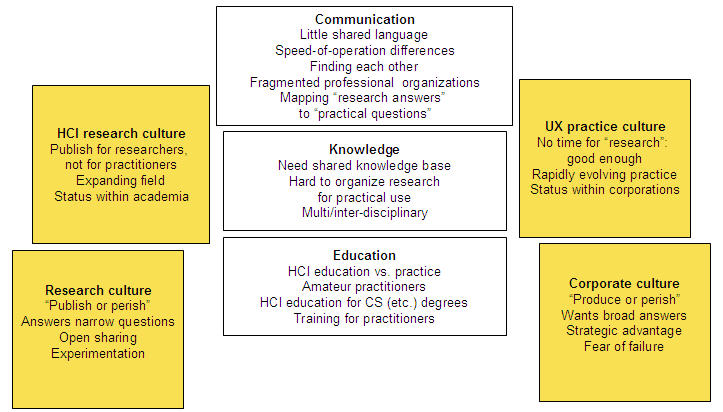
- There is a "pillar" of challenges associated with the research culture overall and the HCI research culture in particular. Those are on the left.
- Similar pillar of challenges on the right: the corporate culture overall and user experience practice culture in particular.
- It is hard to change culture. There may be some opportunities to address some of the challenges directly in each/both pillars, but be aware what you are getting yourself into if you try to tackle them.
- There are 3 levels of bridging, across the middle: Education (fundamental training and schooling), Knowledge-sharing (helping researchers and practitioners by sharing details on a regular basis) and Communication (just making sure we can talk with each other in an intelligent way).
- Improving simple communication between researchers and practitioners is one place to start. Sharing knowledge is harder (but has the bigger pay-off) and forming an educational foundation should lead to the ability to address deeper challenges.
Net: what I learned at CHI is helping me understand the landscape. It also inspired me to continue with all of this.
But the workshop/SIG had some specific goals around driving improvements for future CHI conferences. Lots of good ideas were generated, but like all volunteer efforts, they only come to be when someone steps up to make them happen. Here is what is in the works for CHI 2011 to improve researcher-practitioner interaction:
- Communities, communities, communities. Arnie Lund is leading a revival of the community aspect of the CHI conference. The 4 "established" communities drive specific parts of the program and act as "entry points and guides for researchers and practitioners...help attendees and authors find ways to connect with the conference more effectively." New in 2011 are "featured" communities that provide more ways to increase RPI. For example, Health lists the benefits of research-practice interaction several times.
- For the UX community (that I am most interested in), Elizabeth Buie and Jhilmil Jain are building upon the CHI 2010 workshop that they helped organize. They have set up a LinkedIn group for the CHI UX community to help the cause. Join it!
- There are other efforts in progress to fine-tune parts of the process and to make the program more accessible to practitioners (like, doing a better job of providing "practitioner take-aways" for research papers). As I hear about specific advances, I will let you know. The key is always volunteers to make things happen, so if you are interested in helping out, let me know and I will put you in touch with the right people.
Norman, translational developers
As you start pouring time into a volunteer effort like this, you start to wonder if this is an important problem to try to solve. If you are lucky, then someone prominent is reaching the same conclusions as you are. That happened in May when Don Norman published his The Research-Practice Gap article. It appeared in the July/August 2010 issue of interactions later. A must-read for anyone interested in this topic.
When I posted a comment on my site about the article, I mentioned I did not agree with everything in the article. Don replied and that started some email discussion back and forth between us. So in the spirit of disagreeing a bit, let me point out a few things about the article (knowing it is dangerous to debate with someone who is a lot smarter than you):
- I do agree that the gap between researchers and practitioners exists within professional associations (and their conferences), but one thing that Don does not point out is that those are some of the best means to address the gaps. Don calls for a new discipline, translational developers: it should be created within our existing organizational structures, in my opinion.
- Separate "discipline"? I am not convinced we need a new "discipline" - maybe we just need more people who are willing/capable of working across disciplines. Find ways to have more people spend a few years as a researcher, then a few years as a practitioner, and so on. And "discipline" seems academic: I am more interested in business models which make this a career path that our best and brightest are interested in.
- Translational developers? Why "developers"? In my UX practitioner world, "developers" means you write code. In one of his talks, Don used the term Translational Engineering. A little better. I think we need some work on what to call this thing. "Translational entrepreneur"?: someone who has figured out how to get rich doing this.
And on a more "write a better article" slant, I enjoyed learning about Pasteur's quadrant but it really bugged me that the article did not include a figure that was an actual quadrant. So I drew one myself - and Don kindly made it better.
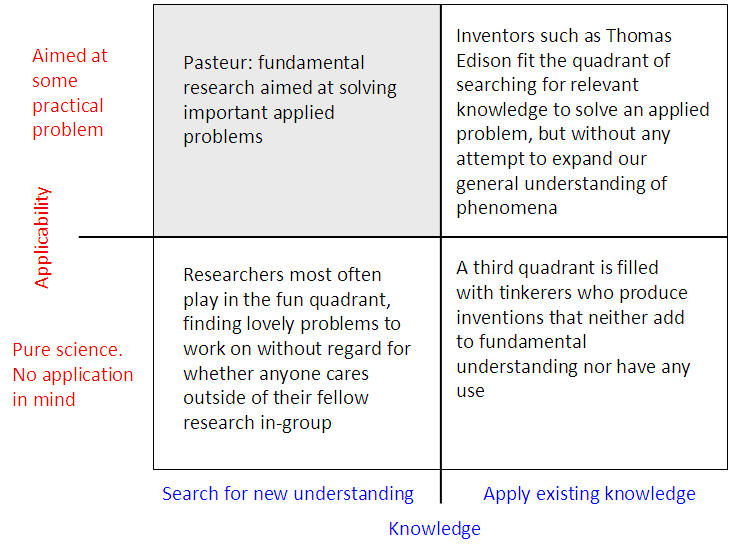
I have not seen any blog postings or online discussions of Don's article, so maybe this post will stir up something. Having Don "raise the flag" should help all of us make progress.
Internet User Experience panel
Don's article was one of the topics at a panel I organized at the IUE conference (slides, Twitter stream and other details). I hope the attendees found the session useful, but I liked it because:
- I got 3 more people engaged as panelists. Susan Weinschenk, Danielle Cooley and Mark Newman did prep work together to create short and long versions of their position on different issues. They have their own critiques of Norman's article, for example: now we need to figure out how to get the discussion going.
- We did more napkin drawing to get the audience engaged. That has worked twice now, I want to keep doing it more.
- One of Mark's points was about the trend of translational research that is catching on in medicine. This is a good reminder that many fields are struggling with the same issues: we may need to look beyond our traditional "industry" for some answers.
Again, check out the compilation of info about the panel to find out more. These are just a few hi-lites.
Demarcating UX
One more thing to mention. I was invited to the Demarcating User eXperience seminar that took place 2 weeks ago. I could not make it, but Elizabeth Buie kindly agreed to attend to help connect researcher-practitioner interaction efforts.
This quote from the seminar shows the relationship: "UX is seen as a holistic concept covering all aspects of experiencing a phenomenon, but we are facing the point where UX has become a concept too broad to be useful in practice. Practitioners have difficulties to understand the concept and to improve UX in their work, and researchers rather use some other term to make their research scope clear."
From what I have heard (and seen), the seminar went well and I am looking forward to what they share as a result (some sort of white paper). You can check out the position papers and other preparation material.
Since I was not there, I will not comment a lot on the preparation material, but my personal favorites are statements from the practitioners whom I know.
- Nigel Bevan: "UX Should Not be Demarcated!"
- Elizabeth: "If the practitioners can't use it [the white paper], it doesn't work!"
- David Gilmore: About the relativity of experience, and the innovation cycle
Staying in touch
As these different strands of activity progress - and more crop up - and we discover other strands that are already in motion, staying in touch with it all is a big challenge. What is the simplest thing we can do? To me, that is to use a common tag that people can attach to different objects that represent progress in researcher-practitioner interaction.
I did some poking around and thought that uxrpi would be a good starting point. Short form of "User experience researcher-practitioner interaction". So I started tagging my tweets with it. And Flickr photos. And this blog posting. Let's see if it provides any value. If we need more mailing lists or groups or whatever, then that is fine, we can do that too.
If this post inspires you to write up your own comments on Don's article, or to dispute something that I said, or if you know of more going on to try to improve researcher-practitioner interaction, use the UXRPI tag. That will help others discover it.
What is next for me? A keynote about this for the Tri-State World Usability Day at LexisNexis & Elsevier in Dayton (Ohio) on November 11th. Hope to see some of you there!
(Oh, and this really did start out as a short blog post. Then it grew and grew and grew...)

Recent comments